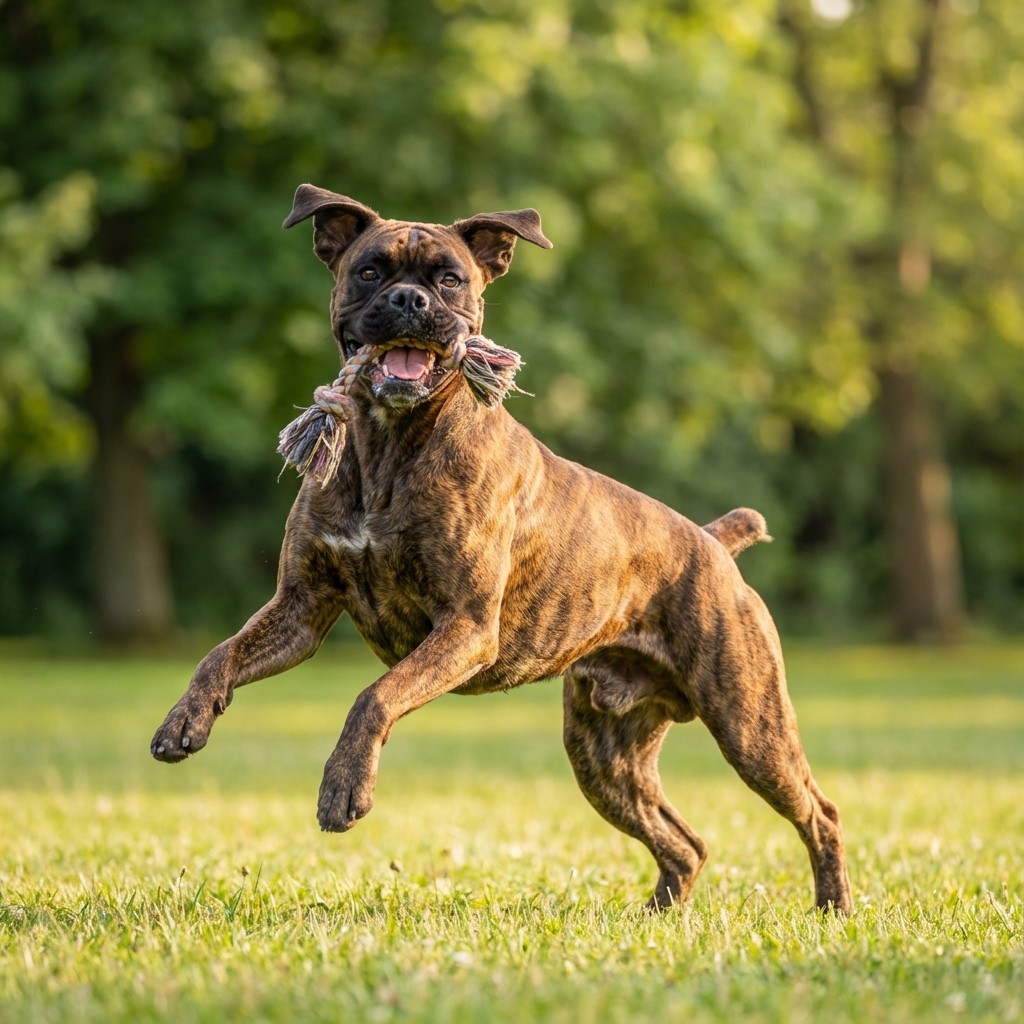
Boxer
The Boxer is a medium-to-large German breed descended from the Bullenbeisser, developed as a working dog and known for its playful temperament, strong guarding instincts, and characteristic broad muzzle.
The Boxer is named for its habit of standing on its hind legs and “boxing” with its front paws during play. Despite their muscular build and serious expression, Boxers are famously playful, affectionate, and slow to mature. They remain high-energy and puppy-like well into adulthood. They are devoted guardians and equally enthusiastic family companions.
History and Origin: The Bull Biter
The Boxer was developed in Germany in the late 19th century.
- The Ancestor: It descends from the now-extinct Bullenbeisser (“Bull Biter”). These were heavy, powerful hunting dogs used to seize bear, boar, and deer and hold them until the hunter arrived.
- The Refinement: To create the modern Boxer, German breeders crossed the Bullenbeisser with smaller Mastiff-type dogs and Bulldogs. The goal was to create a smaller, faster, but still powerful working dog.
- The War Hero: Boxers served with distinction in both World Wars as messenger dogs, pack carriers, and guard dogs. After WWII, returning American soldiers brought them home, where they became instant family favorites. The breed has been one of America’s most popular dogs ever since.
Physical Characteristics: The Athlete
The Boxer is the athlete of the dog world. Every muscle is clearly defined under his tight skin.
- Height: Males 23–25 inches (58-63 cm); Females 21–23 inches (53-60 cm).
- Weight: Males 65–80 pounds (29-36 kg); Females 50–65 pounds (22-29 kg).
Distinctive Features
- The Head: The head is the breed’s hallmark. It must have a broad, blunt muzzle and an “undershot” jaw (the lower jaw extends slightly beyond the upper). This structure allowed his ancestors to breathe while holding onto prey.
- The Body: Square-built, short-backed, and tightly muscled.
- The Coat: Short, shiny, and smooth.
- The Colors:
- Fawn: Ranges from light tan to mahogany red.
- Brindle: Black stripes on a fawn background.
- Flash: White markings on the face, chest, and feet are common and flashy.
- White Boxers: About 20-25% of Boxers are born white. They are not albinos, but they are prone to deafness and skin cancer. They are not recognized for showing but make excellent pets.
Temperament and Personality
Boxers are energetic, affectionate, and characteristically exuberant.
The Kidney Bean Dance
When a Boxer is happy to see you (which is always), he wiggles his entire body into a “C” shape, bending in the middle. This is affectionately known as the “kidney bean” dance. His tail (often docked in the US, natural in Europe) wags his whole body.
Good with Children
Boxers are generally patient and tolerant with children in the family. However, they are exuberant jumpers and may accidentally knock a toddler over.
Protective
They are natural guardians. They are alert and will back down an intruder with a deep bark and a formidable stance. But unlike some guard breeds, they generally warm up quickly once they see the owner is at ease. They are lovers, not fighters.
Training and Exercise Needs
Exercise: High Energy
Boxers need a lot of exercise. A bored Boxer is a destructive Boxer.
- Daily Needs: At least 90 minutes of vigorous activity. They are not apartment dogs unless you run them daily.
- Play: They love to jump and play rough. They need durable toys.
- Heat Intolerance: Because of their short muzzle (brachycephalic), they overheat easily. Exercise in the cool of the morning or evening during summer.
Training
Boxers are smart but stubborn.
- Repetition: They get bored easily. If you do the same drill 10 times, they will start making up their own rules just for fun. Keep training sessions short, varied, and positive.
- Corrections: They are sensitive souls. Do not use harsh punishment. A harsh word can crush their spirit. They respond best to treats and praise.
- Jumping: You must teach them early not to jump up. It is their natural greeting.
Health and Lifespan
The Boxer’s biggest downfall is his health. They have a shorter lifespan of 10 to 12 years and are prone to several serious conditions.
- Cancer: This is the heartbreak of the breed. Boxers have one of the highest rates of cancer of any breed (mast cell tumors, lymphoma, brain tumors). You must check every lump and bump immediately.
- Boxer Cardiomyopathy (ARVC): A genetic heart condition that causes irregular heartbeats and can lead to sudden death.
- Aortic Stenosis: Another heart defect.
- Bloat (GDV): Common in deep-chested dogs.
- Hip Dysplasia: Joint issues.
- Degenerative Myelopathy (DM): A painless, progressive nerve disease affecting the hind legs.
Grooming and Care
- Coat: Very low maintenance. A weekly rubdown with a hound glove or rubber curry brush keeps the coat shiny.
- Drool: Not all Boxers drool, but many do, especially after eating or drinking. “Slingers” are a real thing.
- Wrinkles: Clean the wrinkles on the face with a damp cloth to prevent infection.
- Nails: Keep them short.
Is a Boxer Right for You?
The Boxer is a dog that lives life at full volume.
Yes, if:
- You are an active person. You want a running partner.
- You want a dog with a sense of humor. He will keep you laughing.
- You have a family. He loves kids and is a great playmate.
- You want a guard dog that isn’t overly aggressive. He has a sensible guard instinct.
No, if:
- You work long hours. Boxers are needy. They genuinely suffer from separation anxiety.
- You want a calm, dignified dog. He is a goofball.
- You can’t handle a dog that jumps. It takes training to stop.
- You are not prepared for potential health heartbreak. Cancer is a real risk.
The Boxer is a physically demanding, affectionate breed that suits active households. He is a capable guardian and a loyal companion who requires consistent training and significant daily exercise.
Related Breeds

Greyhound
Der Greyhound ist ein uralter Sichthund, der Sprintgeschwindigkeiten von bis zu 72 km/h erreicht. Di...

Afghan Hound
The Afghan Hound is an ancient sighthound from the mountains of Afghanistan, known for its long, sil...

Akita
With their massive heads, curled tails, and silent strength, the Akita is a loyal, dignified protect...