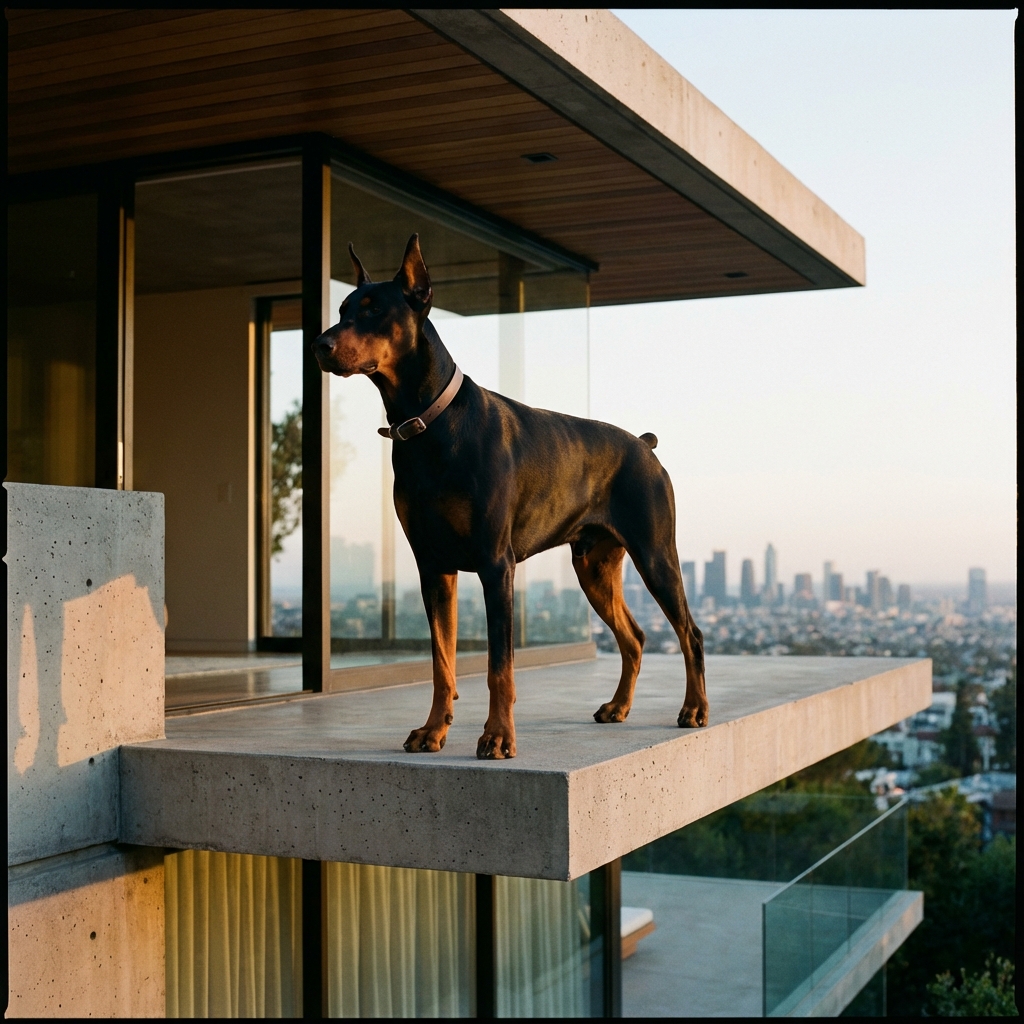
Doberman Pinscher
The Doberman Pinscher is a large working breed developed in Germany in the late 19th century by Louis Dobermann, widely used in police and military roles due to its intelligence, speed, and protective instincts.
The Doberman Pinscher (or simply “Dobermann” in Europe) is a medium-large working breed known for its athletic build, short glistening coat, and traditionally cropped ears. The breed has a striking silhouette and is widely recognized.
Despite a reputation as a ferocious guard dog—reinforced by decades of cinematic portrayals—a well-bred Doberman is a stable, affectionate family protector. The breed bonds closely with its owners and tends to shadow them throughout the home. A Doberman does not thrive as a yard dog kept apart from the family.
History and Origin: The Tax Collector’s Dog
The breed has a fascinating and practical origin story. It was created in the late 19th century by a German tax collector named Louis Dobermann.
- The Problem: Herr Dobermann had a dangerous job. He had to travel through bandit-infested areas of Thuringia, Germany, to collect taxes. He was also the local dogcatcher, giving him access to many breeds.
- The Solution: He decided to create a dog that was impressive enough to scare off attackers but loyal enough to be a companion. He wanted a dog that was “sharp” (quick to bite if needed) but intelligent.
- The Recipe: He crossed several breeds—likely the Rottweiler (for strength), the Black and Tan Terrier (for tenacity), the German Pinscher (for speed), and perhaps the Greyhound and Weimaraner.
- The Result: The “Dobermann’s Dog” was born. Lean, mean, and incredibly smart, they quickly became the preferred dog for police and military work. They famously served as “Devil Dogs” with the US Marines in the Pacific theater of WWII, saving countless lives.
Physical Characteristics: Aero-Dynamic
The Doberman is a medium-large dog with a square, muscular build. He should look like an athlete in peak condition—no extra fat, just muscle and bone.
- Height: Males 26–28 inches (66-71 cm); Females 24–26 inches (61-66 cm).
- Weight: Males 75–100 pounds (34-45 kg); Females 60–90 pounds (27-41 kg).
The Look
- Ears: Traditionally cropped to stand erect (originally for better sound localization and to prevent attackers from grabbing them), but many owners now leave them natural (floppy).
- Tail: Traditionally docked (shortened), but natural tails are becoming common in countries where cropping/docking is banned.
- Coat: Short, smooth, hard, and thick. It lies close to the body.
- Colors: Black, Red, Blue (dilute black), and Fawn (dilute red)—all with sharply defined rust markings above each eye, on the muzzle, throat, and chest, and on all four legs and feet.
- The “White” Doberman: A genetic mutation produces albino Dobermans. These dogs suffer from serious health issues (photosensitivity, skin cancer, temperament instability) and are considered a disqualification by responsible breed clubs.
Temperament and Personality
Dobermans are intense. They do nothing halfway.
The Personal Protector
They are arguably the world’s best personal protection dog. They are fearless but not reckless. They are highly attuned to their owner’s emotions. If you are afraid, they are instantly on alert. If you are calm, they are calm. They analyze situations rather than just reacting blindly.
Intelligence
Ranked the 5th smartest dog breed, they learn lightning fast. They are “thinking” dogs. They can open doors, figure out puzzle toys, and will constantly test the household rules. If they don’t respect you as a leader, they will happily take over the role themselves.
Emotionally Sensitive
Despite their tough exterior, Dobermans are emotionally sensitive. They follow their owners closely throughout the home and do not thrive as backyard dogs. Isolation can lead to anxiety, destructive behavior, or aggression. They need to be integrated into family life.
Training and Exercise Needs
Exercise: The Athlete
A Doberman is an athlete who needs to burn energy.
- Daily Needs: At least 90 minutes of vigorous exercise every day. A walk around the block is not enough.
- Running: They are excellent running partners (once fully grown).
- Mental Work: They need a job. A bored Doberman is a destructive weapon. Obedience, agility, Schutzhund (protection sports), or nose work are essential to keep their brilliant minds occupied.
Training: Mandatory
Training is not optional. An out-of-control Doberman is dangerous and a liability.
- Firmness: They need a confident, consistent leader. They respect fairness, not brute force.
- Socialization: You must expose them to friendly strangers, children, and other dogs early and often. They naturally suspect everyone is a “bad guy,” so you must teach them that most people are friends. A poorly socialized Doberman is a fear-biter.
Health and Lifespan
Dobermans live 10 to 12 years, but the breed faces a serious health crisis that potential owners must know about.
- Dilated Cardiomyopathy (DCM): An enlarged heart that fails to pump blood effectively. This is the #1 killer of Dobermans. It is estimated that up to 50% of Dobermans will develop this condition. It can cause sudden death in seemingly healthy dogs. Regular annual echocardiograms and Holter monitor testing are essential.
- Von Willebrand’s Disease (vWD): A genetic bleeding disorder (like hemophilia). A simple DNA test can identify carriers.
- Wobbler Syndrome: A spinal issue in the neck that causes a wobbly gait and pain.
- Bloat (GDV): Deep-chested dogs are at risk of stomach twisting.
- Cold Sensitivity: They have no undercoat and very little body fat. They hate the cold and rain. They need a coat in winter and should not be left outside.
Grooming and Care
- Coat: Very low maintenance. A “wash and wear” dog. Brush occasionally with a rubber mitt to minimize shedding.
- Nails: Keep them short. Long nails can cause joint pain.
- Ears: If cropped, they require months of taping puppy ears to stand (a commitment). If natural, clean them weekly.
- Teeth: Daily brushing is recommended.
Is a Doberman Pinscher Right for You?
The Doberman Pinscher is a highly capable working breed, but he is not suited for first-time owners.
Yes, if:
- You are an active person. You run, hike, or train dogs as a hobby.
- You want a serious guardian. You want a dog with strong protective instincts.
- You are a strong leader. You are consistent, firm, and fair.
- You want a dog that is glued to your side. You don’t mind a 90-pound shadown.
No, if:
- You work long hours. He will destroy your house out of boredom and loneliness.
- You are a first-time owner. He is too smart and too strong for a novice.
- You live in a very cold climate. Unless you want to buy a wardrobe of dog sweaters.
- You want a dog that loves everyone at the dog park. He can be same-sex aggressive and standoffish.
For the right owner, the Doberman Pinscher is an exceptionally capable and loyal companion. The breed requires a significant commitment to training, exercise, and veterinary care, particularly given its cardiac health concerns.
Related Breeds

Greyhound
Der Greyhound ist ein uralter Sichthund, der Sprintgeschwindigkeiten von bis zu 72 km/h erreicht. Di...

Afghan Hound
The Afghan Hound is an ancient sighthound from the mountains of Afghanistan, known for its long, sil...

Akita
With their massive heads, curled tails, and silent strength, the Akita is a loyal, dignified protect...