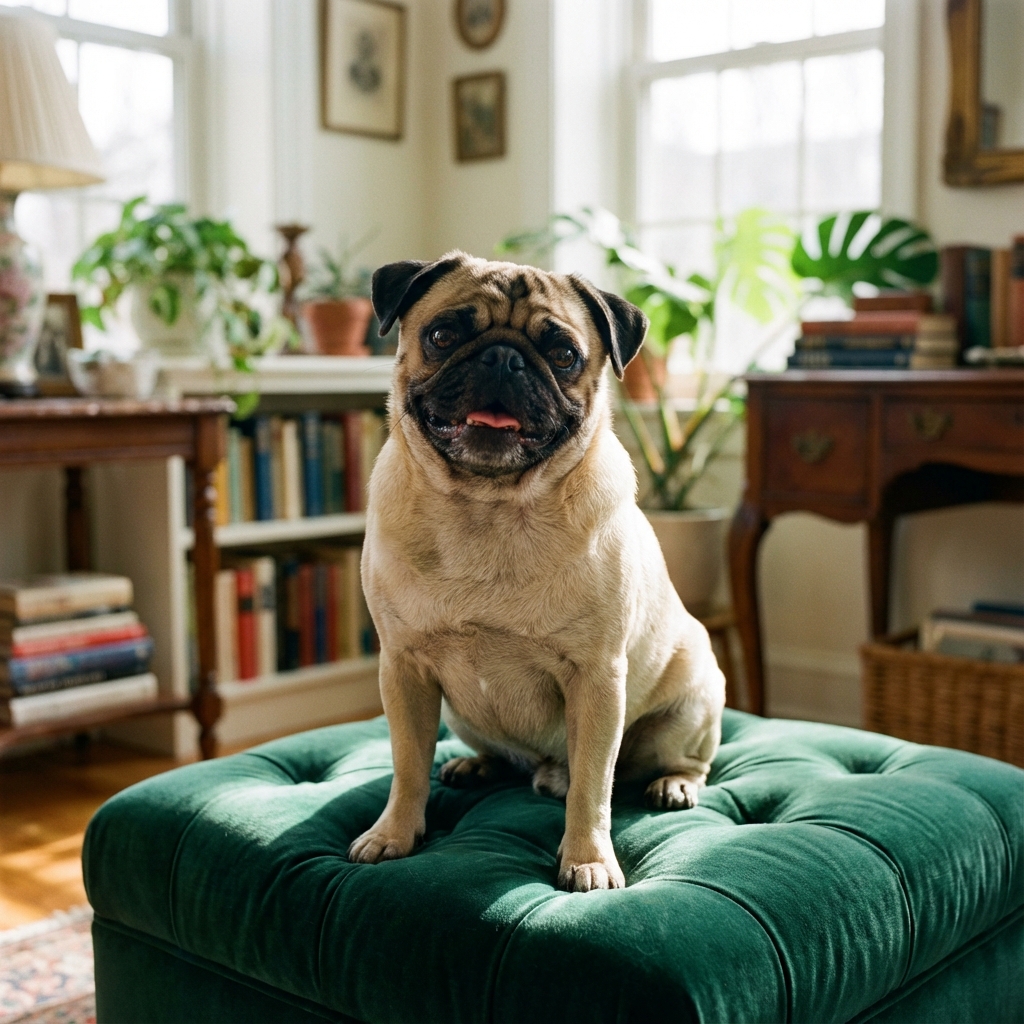
Pug
The Pug is an ancient Chinese toy breed dating to the Han Dynasty, brought to Europe by Dutch traders in the 16th and 17th centuries. Known for its flat face, deep facial wrinkles, and curled tail, the breed was developed as a companion dog.
The Pug carries the Latin motto multum in parvo—“a lot in a little”—reflecting its substantial personality in a compact body. With its wrinkled brow, flat face, and tightly curled tail, the breed has a distinctive appearance immediately recognizable worldwide.
The Pug was bred exclusively as a companion dog. Unlike most breeds, it was not developed for hunting, guarding, or retrieving. It is among the most people-oriented breeds, preferring close physical proximity to its owners throughout the day.
History and Origin: The Emperor’s Favorite
The Pug is an ancient breed with a history that begins in the Imperial courts of China. Dating back to the Han Dynasty (around 200 B.C.), short-nosed dogs known as “Lo-Sze” were the pampered pets of the Emperors. They lived in luxury, often guarded by soldiers, and were considered so valuable that only royalty could own them. These dogs were bred to be small enough to sit on an emperor’s lap and had the wrinkles that were prized because they resembled the Chinese character for “prince.”
The Royal Mascot
In the 1500s and 1600s, Dutch traders brought the Pug to Europe, where they became an instant sensation.
- The House of Orange: The Pug became the official dog of the House of Orange (the Dutch royal family) after a Pug named Pompey saved the life of the Prince of Orange by barking to alert him to an approaching assassin.
- Josephine’s Messenger: Napoleon’s wife, Josephine, used her Pug, “Fortune,” to carry secret messages to her family while she was imprisoned during the French Revolution. (The messages were hidden under his collar).
- Queen Victoria: In England, Queen Victoria bred Pugs and helped establish the Kennel Club, cementing the breed’s popularity.
Physical Characteristics: Square and Cobby
The Pug is described as “cobby,” a British term meaning square, thickset, and muscular. He should not be lean or leggy; he should look like a brick.
- Height: 10–13 inches (25-33 cm).
- Weight: 14–18 pounds (6-8 kg). A Pug should feel heavy for his size.
Distinctive Features
- The Face: The face is flat (brachycephalic) with deep, large wrinkles around the nose and forehead. The large, dark, globular eyes give him a soft, soliciting expression that is hard to resist.
- The Tail: The tail is the breed’s signature. It is set high and curled tightly over the hip. A double curl is considered perfection in the show ring.
- The Coat: The coat is short, smooth, and glossy.
- Colors: Pugs come in Fawn (tan) or Black. Fawn Pugs have a black mask and black ears, providing a striking contrast.
Temperament and Personality
The Pug is a lover, not a fighter. He is generally stable, even-tempered, and optimistic.
The Shadow
Pugs seek close proximity to their owners throughout the day. They will follow room to room, preferring to be touching their person when resting. They do not tolerate extended periods of solitude well and may exhibit separation anxiety.
The Social Butterfly
He is rarely aggressive. He loves children, tolerates other dogs, and generally assumes that every stranger is just a friend he hasn’t met yet. He is sturdy enough to play with kids but calm enough to be a companion for seniors.
The Clown
He has a sense of humor. Pugs love to show off and be the center of attention. They will do silly things just to get a reaction. However, they can also be dignified and stubborn if they feel they are being laughed at rather than with.
Training and Exercise Needs
Exercise: The Couch Potato Pattern
He is not a marathon runner.
- Daily Needs: A short, brisk walk or some indoor playtime is sufficient. He spends most of his day napping.
- Heat Intolerance: This is critical. Because of his flat face, the Pug cannot cool himself efficiently by panting. He is extremely susceptible to heatstroke. In hot weather, he must be kept in air conditioning. Walks should be limited to early mornings or late evenings.
Training: Food is Key
Pugs are intelligent but distinctively stubborn. They will ask, “What’s in it for me?”
- Motivation: They are incredibly food-motivated. You can train a Pug to do anything for a cookie. But be careful—they are prone to obesity.
- Housebreaking: This can be a challenge. Small dogs have small bladders, and Pugs dislike rain and cold. Patience and a consistent schedule are required.
Health and Lifespan
Pugs typically live 13 to 15 years, but they are a “high maintenance” breed medically. Owning a Pug means being prepared for vet visits.
- Brachycephalic Obstructive Airway Syndrome (BOAS): Their flat faces mean crowded airways. Many Pugs snort and snore. Some require surgery to widen their nostrils or shorten their soft palate to breathe comfortably.
- Eye Injuries: Their large, protruding eyes are easily scratched or injured. “Proptosis” (the eye popping out) is a terrifying but possible risk if the dog is handled roughly or pulls hard on a collar (always use a harness).
- Pug Dog Encephalitis (PDE): A unique, fatal inflammation of the brain that affects young Pugs. Genetic testing is available.
- Skin Infections: The wrinkles on the face must be kept clean and dry to prevent fungal and bacterial infections.
- Obesity: A fat Pug is a breathless Pug. You must measure their food.
Grooming and Care
The Shedding
Do not let the short coat fool you. Pugs shed. Included in “multum in parvo” is “a lot of hair from a small dog.” They have a double coat that sheds year-round.
- Brushing: Daily brushing with a rubber mitt helps control the hair tornado.
- Wrinkle Cleaning: You must wipe the folds over the nose daily with a damp cloth or baby wipe, then dry them thoroughly. If left damp, they will smell and become infected.
- Nails: Pugs hate having their feet touched, but their nails grow fast. Start trimming them early.
Is a Pug Right for You?
The Pug is a special dog who typically demands a special place on your furniture.
Yes, if:
- You want a constant companion. You want a dog that is always with you.
- You live in an apartment. He is quiet and low-energy.
- You want a peaceful home. He gets along with everyone.
- You have a sense of humor. His snoring and snorting will make you laugh.
No, if:
- You are an outdoor adventurer. He cannot hike in the heat.
- You want a pristine house. The shedding is heavy for a small dog.
- You are on a tight budget. Health issues can be expensive.
- You want a dog that sleeps silently. Pugs are noisy sleepers.
For owners who want a calm, social companion suited to apartment living, the Pug is a practical choice. Prospective owners should be aware of the breed’s significant health vulnerabilities and be prepared for associated veterinary costs.
Related Breeds

Alaskan Klee Kai
The Alaskan Klee Kai is a small, energetic spitz breed developed in Alaska in the 1970s, resembling ...

American Eskimo Dog
The American Eskimo Dog is a Nordic spitz breed descended from German Spitz dogs, known for its whit...

American Hairless Terrier
Smart, spirited, and hypoallergenic, the American Hairless Terrier is a lively companion that thrive...