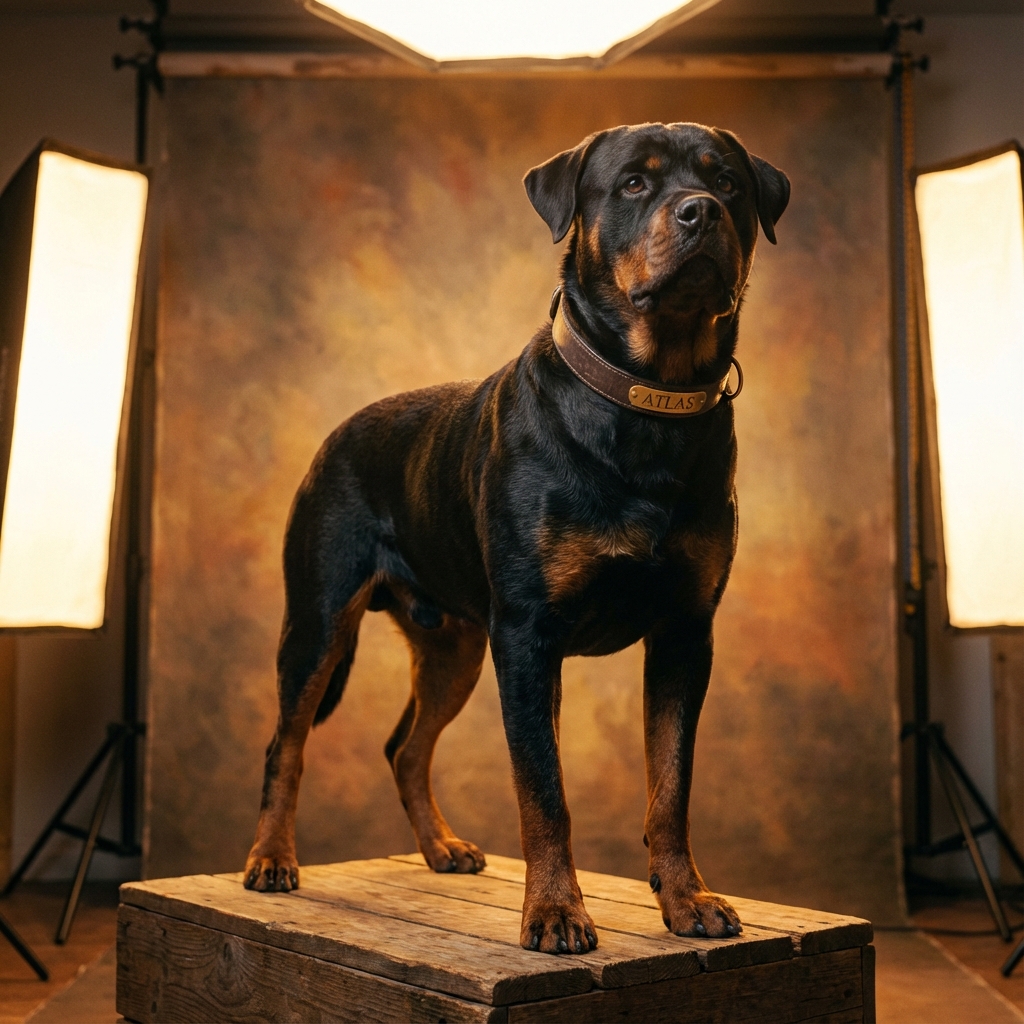
Rottweiler
The Rottweiler is a powerful German working breed descended from Roman drover dogs, historically used to herd cattle and pull butchers' carts in the town of Rottweil. Today the breed serves in police, military, and search-and-rescue roles.
The Rottweiler is a large, powerful working breed descended from the mastiffs of the Roman legions. Often depicted as aggressive in popular media, a well-bred and well-socialized Rottweiler is in fact a calm, confident guardian with strong attachment to its family.
Known informally as the “Rottie,” the breed is intensely people-oriented, prone to leaning against its owners and following them closely. It requires confident, consistent handling and is not recommended for inexperienced dog owners.
History and Origin: The Butcher’s Dog
The Rottweiler’s history is ancient and fascinating.
- Roman Roots: The breed’s ancestors were likely the molossus dogs (mastiffs) that accompanied the Roman legions as they marched across the Alps into Germania. These dogs had a critical job: driving and guarding the herds of cattle that fed the army.
- The Town of Rottweil: When the Romans settled in the area that is now Rottweil, Germany, their dogs remained. Over centuries, they were bred with local dogs to create the ultimate herder and protector.
- The “Metzgerhund”: In the Middle Ages, they became known as the Rottweiler Metzgerhund (Rottweil Butcher’s Dog). Their job was twofold: to drive cattle to market and, on the way home, to protect the butcher’s money pouch, which was tied around their neck for safekeeping. No thief was foolish enough to try to rob a Rottweiler.
- Near Extinction: With the advent of railroads in the 19th century, cattle driving became obsolete. The breed nearly went extinct. In 1905, there was reportedly only one female Rottweiler left in the town of Rottweil.
- The Police Dog: Fortunately, the breed found a new calling in the early 20th century: police work. Their intelligence, strength, and intimidation factor made them perfect K-9s. They were officially recognized as police dogs in 1910.
Physical Characteristics: A Powerhouse
The Rottweiler is a powerhouse. Everything about him says “strength.” He is robust, muscular, and substantial.
- Height: Males 24–27 inches (61-69 cm); Females 22–25 inches (56-63 cm).
- Weight: Males 95–135 pounds (43-61 kg); Females 80–100 pounds (36-45 kg).
Distinctive Features
- The Build: Massive, broad, and deep-chested. He is not built for speed but for endurance and strength. He should look compact and powerful, not leggy or weedy.
- The Head: Broad and blocky with a strong jaw. The forehead is wrinkled when alert.
- The Coat: Short, hard, and thick. It is double-coated, with the undercoat present on the neck and thighs.
- The Colors: Always black with clearly defined rust or mahogany markings on the cheeks, muzzle, chest, legs, and under the tail. “Pencil marks” on the toes are desirable.
- The Tail: Historically docked to prevent injury while herding, but many countries (and owners) now leave the tail natural. A natural tail is long, strong, and carried level with the back or slightly up.
Temperament and Personality
The ideal Rottweiler is calm, confident, and courageous. He should not be fearful or aggressive without cause.
The “Wait-and-See” Attitude
A Rottweiler does not bark at the wind. He is a thinking dog. If a Rottweiler barks, you should pay attention. He tends to hang back and observe new situations rather than rushing in to make friends immediately. This aloofness is often mistaken for unfriendliness, but it is simply his way of assessing the situation.
Attachment to Their People
Contrary to their tough image, Rotties are intensely people-oriented. They can suffer from separation anxiety if left alone for extended periods. They frequently “lean” — pressing their bodies against their owners’ legs — and prefer to be in the same room, a behavior likely linked to their herding ancestry.
Aggression vs. Protection
A well-socialized Rottie is not aggressive. He is protective. There is a difference. A protective dog reacts to a real threat; an aggressive dog reacts to everything out of fear or dominance. However, because they are so powerful, an untrained or unsocialized Rottweiler is dangerous. He requires an experienced owner who can provide firm, fair consistent leadership.
Training and Exercise Needs
This is not a breed for beginners. If you are a first-time dog owner, think twice before getting a Rottweiler.
Socialization: The Golden Rule
This is the most critical factor in raising a Rottweiler. You must introduce a Rottweiler puppy to everything—children, men in hats, other dogs, loud noises—before they are 6 months old. They need to learn that the world is safe. An unsocialized Rottweiler will grow up suspicious and fearful, which leads to biting.
Training: Fairness and Firmness
They are highly intelligent and want to work.
- Obedience: Mandatory. You must be able to control your dog verbally. He is too strong to control physically.
- Methods: They respond best to firm, consistent direction and reward-based training. Physical punishment can backfire, causing the dog to become defensive or aggressive. You must be the “alpha” through respect, not fear.
Exercise: A Working Dog
They are working dogs with endurance.
- Daily Needs: At least 45-60 minutes of vigorous exercise. A walk is good, but they need more.
- A Job: They respond well to working tasks. Cart pulling, obedience trials, tracking, and herding (they retain the instinct) are excellent outlets. Carrying a backpack on walks also provides a sense of purpose.
Health and Lifespan
Rottweilers are a large breed with a relatively short lifespan of 9 to 10 years. Loving a Rottie means accepting that their time is limited.
- Bone Cancer (Osteosarcoma): This is a prevalent killer in the breed. It is aggressive and painful.
- Hip and Elbow Dysplasia: Very common. Responsible breeders screen parents for this.
- Parvovirus: Rottweiler puppies are uniquely susceptible to Parvo. It hits them harder than other breeds. Follow your vet’s vaccination schedule religiously and keep puppies away from public areas until fully vaccinated.
- Bloat (GDV): As with all deep-chested dogs, the stomach can twist.
- Obesity: They love food and will gain weight easily if not exercised.
Grooming and Care
- Coat: Low maintenance. A rubber curry brush or hound glove once a week will keep the coat shiny.
- Shedding: Moderate, but they “blow coat” heavily twice a year (spring and fall).
- Drool: Some Rotties drool, especially if they have loose jowls (flews). It’s not as bad as a Mastiff, but keep a rag handy.
- Nails: Keep them short. Hearing them click on the floor means they are too long.
Is a Rottweiler Right for You?
The Rottweiler is a serious commitment.
Yes, if:
- You have experience with large, powerful dogs. You know how to be a leader.
- You have time for training. You are willing to put in the work every day.
- You want a devoted guardian. You want a dog that will watch your back.
- You don’t mind a 100-pound shadow. You want a dog that is always with you.
No, if:
- You are a first-time dog owner. He will outsmart and overpower you.
- You are intimidated by big dogs. He will sense your fear.
- You can’t commit to socialization. This is dangerous.
- Your landlord or insurance company bans the breed. Sadly, breed-specific legislation is common.
The Rottweiler combines physical strength and protective instinct with deep attachment to its family. For the right owner — experienced, consistent, and committed to socialization — the breed is a reliable and devoted companion.
Related Breeds

Greyhound
Der Greyhound ist ein uralter Sichthund, der Sprintgeschwindigkeiten von bis zu 72 km/h erreicht. Di...

Afghan Hound
The Afghan Hound is an ancient sighthound from the mountains of Afghanistan, known for its long, sil...

Akita
With their massive heads, curled tails, and silent strength, the Akita is a loyal, dignified protect...