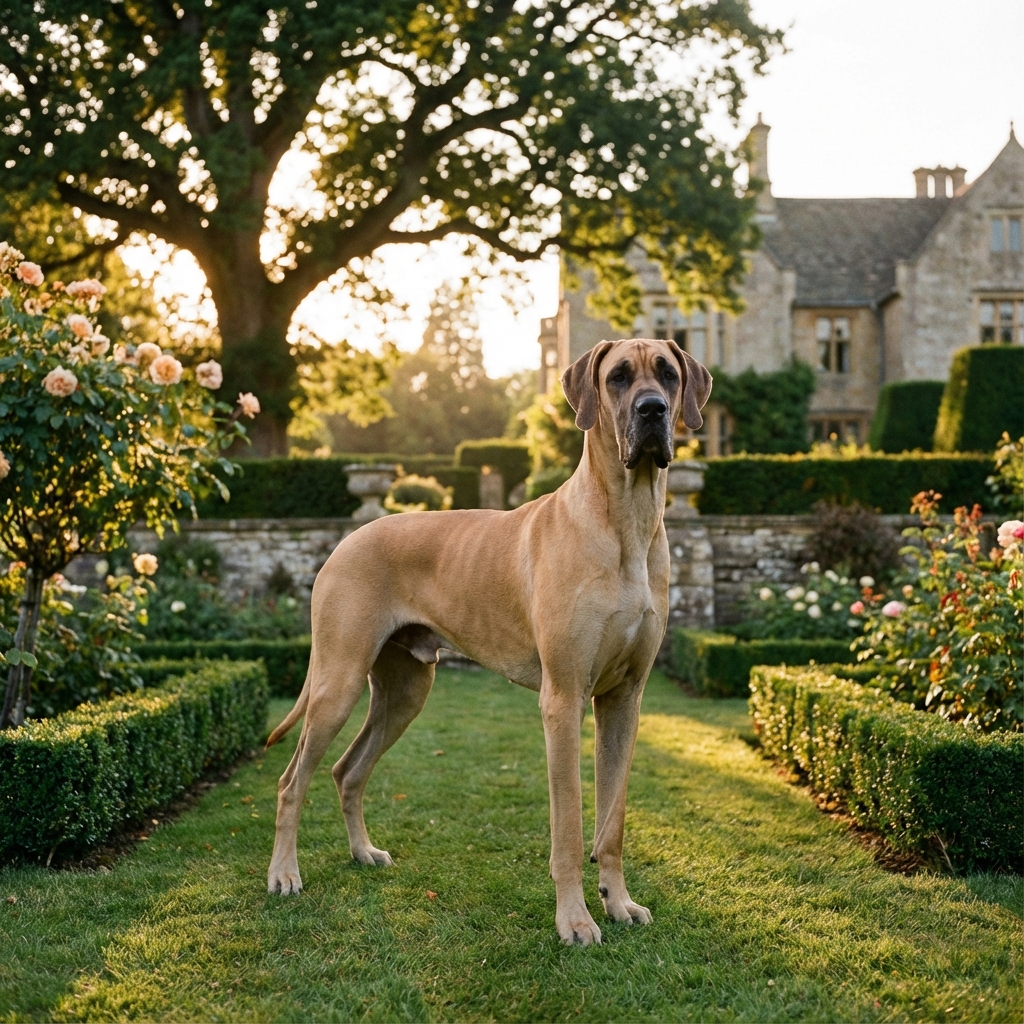
Great Dane
The Great Dane is a giant breed originating in Germany, historically used to hunt wild boar. Known as the Deutsche Dogge, it combines great size with a calm, affectionate temperament and is one of the tallest dog breeds in the world.
The Great Dane is one of the largest dog breeds in the world—a towering figure of considerable height and weight. Despite his imposing size, he is widely known for a sweet, affectionate, and sensitive temperament.
He is sometimes called the “Apollo of Dogs” because of his regal, well-proportioned appearance. He is an affectionate family dog who tends to be physically demonstrative—leaning against people and seeking close contact. Owning a Great Dane requires preparation for large food bills, oversized beds, and the practical demands of a giant-breed dog.
History and Origin: The Boar Hunter
Despite his name, the Great Dane is German, not Danish. In Germany, the breed is known as the Deutsche Dogge. The breed’s ancestors were fierce war dogs and hunting dogs used by the nobility. In the Middle Ages, German nobles used these massive dogs to hunt wild boar—a dangerous adversary that required a dog of immense size, strength, and courage to hold down until the hunter arrived.
- From Warrior to Companion: Over centuries, as hunting styles changed and firearms were invented, the need for such ferocity diminished. German breeders began to refine the breed, selecting for a gentler temperament while maintaining the giant size. By the late 1800s, the “Boar Hound” had transformed into the gentle family companion we know today.
Physical Characteristics: The Apollo of Dogs
Everything about a Great Dane is big. He is not just tall; he is substantial.
- Height: Males 30–32+ inches (76–81+ cm); Females 28–30+ inches (71–76 cm).
- Weight: Males 140–175 pounds (64–79 kg); Females 110–140 pounds (50–64 kg).
Colors and Patterns
The breed standard recognizes specific color patterns:
- Fawn: Golden yellow with a back mask. This is the classic “Scooby-Doo” look.
- Brindle: Golden yellow with strong black cross-stripes (tiger stripes).
- Blue: A pure, steely blue-grey.
- Black: Glossy black.
- Harlequin: Pure white base with torn black patches irregularly distributed.
- Mantle: Black with white trim (white collar, chest, and feet), looking like a tuxedo.
- Merle: Pale grey with black torn patches (now recognized for showing in some kennel clubs, but formerly a disqualification).
Temperament and Personality
Great Danes are affectionate and people-oriented dogs who need to be part of family activities.
The Gentle Soul
They are generally patient with children. A Great Dane will often stand still like a statue while a toddler hugs his leg. However, their sheer size can be a hazard; a happy tail wag can knock a small child over like a bowling pin. Supervision is always required, not because of aggression, but because of physics.
The “Leaner”
A Great Dane shows affection by leaning. He will press his shoulder against your thigh and essentially rest his weight on you. This is a sign of trust and love (and sometimes a request for a treat).
The Watchdog
He is generally friendly with strangers, but his size alone is a deterrent. Few burglars are brave enough to enter a house occupied by a dog the size of a pony. If he does bark, it is a deep, thunderous sound that shakes the walls.
Training and Exercise Needs
Exercise: The Couch Potato Myth
Adult Great Danes are often couch potatoes indoors, capable of sleeping 18 hours a day. However, they are not lazy.
- Daily Needs: They need a few brisk walks daily to stay fit and mentally stimulated.
- Puppy Caution: This is critical. You must not over-exercise a growing Great Dane puppy. Their massive bones grow quickly, and high-impact exercise (jolting, jumping, long runs) can cause permanent joint damage. No forced running until they are at least 18-24 months old.
Training: Essential for Giants
Training is not optional for a giant breed. You cannot physically control a 160-pound dog if he decides to pull on the leash.
- Leash Manners: Loose-leash walking must be taught from day one.
- Socialization: A fearful 150-pound dog is dangerous. He must be socialized early and often to people, other dogs, and new environments so he grows up confident and calm.
- No Jumping: You must teach him never to jump up. A jumping Dane can knock down a grown man.
Health and Lifespan
Great Danes have a short lifespan for a dog, typically 7 to 10 years. Prospective owners should be aware of this when considering the breed.
- Bloat (Gastric Dilatation-Volvulus): This is the #1 killer of Great Danes. Their deep chest makes them highly susceptible. The stomach twists, trapping gas and cutting off blood supply. It is a medical emergency that kills in hours.
- Prevention: Many owners opt for a preventative surgery called gastropexy (tacking the stomach to the abdominal wall) to prevent the twisting.
- Management: Feed multiple small meals, use raised bowls (consult your vet, as advice varies), and avoid vigorous exercise for an hour after eating.
- Dilated Cardiomyopathy (DCM): A heart condition often called “Giant Breed Heart.”
- Hip Dysplasia: Joint issues are common.
- Osteosarcoma: Bone cancer is more common in giant breeds.
Grooming and Care
- Coat: The short coat is easy to groom. A weekly brushing with a rubber mitt or hound glove is sufficient.
- Shedding: He sheds an average amount, but because he has so much body surface area, “average” means a lot of hair.
- Drool: Many Danes drool noticeably. Drool can travel considerable distances when the dog shakes its head. Keeping cloth rags available is practical.
- Nails: Keep them short. Hearing the “click-click” on the floor means they are too long and can affect his posture.
Is a Great Dane Right for You?
The Great Dane is a noble friend, but he is expensive and demanding.
Yes, if:
- You want a huge dog with a calm demeanor. You want a “mat” dog who stays in one place.
- You have the space. You have a large vehicle and a house where a giant can turn around without knocking over a vase.
- You can afford it. Everything costs more: food, flea prevention, heartworm meds, and vet bills.
- You don’t mind a lack of personal space. He will be on your feet, on your lap, and in your bed.
No, if:
- You want a dog that lives 15 years. The heartbreak comes too soon.
- You are a neat freak. Drool and size can be messy.
- You want a marathon running partner. He is a sprayer, not a distance runner.
- You live in a tiny apartment with no elevator. Carrying a sick 150-pound dog down stairs is impossible.
For those who have the space and resources for a giant breed, the Great Dane is an affectionate and devoted family companion. He is adaptable indoors, bonds closely with his family, and combines considerable presence with a calm temperament.
Related Breeds

Irish Wolfhound
The gentle giant of Ireland, the Irish Wolfhound is the tallest of all dog breeds, known for his imm...

Leonberger
The Leonberger is a giant breed developed in the 1840s in Leonberg, Germany, by crossing Newfoundlan...

Mastiff
The Mastiff (Old English Mastiff) is one of the heaviest dog breeds in existence, with ancestors use...